
Judo Ne-Waza Part 4: Fundamentals of the Judo Ground Game I Teach My Students by Kirby L. Minor, Divorce & Custody Attorney in Lee's Summit
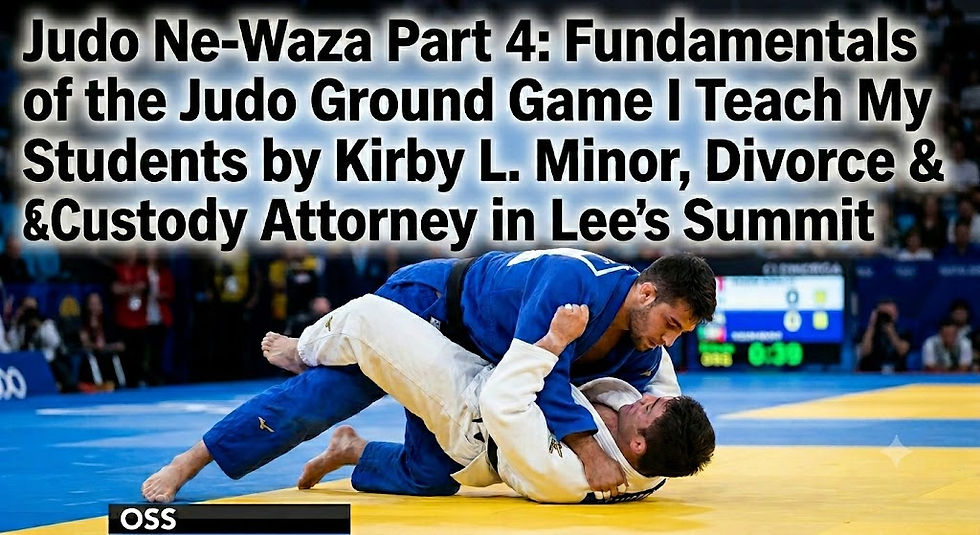
by Kirby L. Minor, Divorce & Custody Attorney in Lee's Summit:
After decades of training and teaching Judo, I’ve distilled the most important ground fighting (Ne-Waza) concepts into a set of core fundamentals. These principles apply whether you’re on the mat or navigating high-conflict custody battles. Here is the personal list I share with every student:
NE-WAZA FUNDAMENTALS
Desire Dominance / Prepare for Non-Dominance
Always prioritize taking and maintaining the top position. Unlike Brazilian Jiu-Jitsu, traditional Judo emphasizes fighting from the dominant position rather than deliberately fighting off your back.
Think Heavy in Dominance / Light in Non-Dominance
When you have the advantage, relax your body completely and become dead weight. When escaping, stay light and fluid.
Tachi-Waza to Ne-Waza (Grip / Knee / Space)
Learn to transition smoothly from standing throws into immediate ground control.
Attacking One Side
Focus your attack on one side to create openings. When facing a stronger opponent, committing all your strength against one side often creates a decisive opportunity.
Head off the Mat
Keep your head elevated for better posture and awareness.
Face Opponent (Head Up / Chest Up)
Maintain a strong, active posture — never bury your face.
Stay on Toes / Do Not Flatten on Instep
Keep mobility and the ability to drive or escape.
Fluidity of Techniques / Seek Balance
Flow between positions instead of forcing one technique.
Offensively Remove Space / Defensively Create Space
Shrink the opponent’s options when attacking; create room to escape when defending.
Controlling with Knees
Use your strongest muscles to pin and control. This includes controlling your opponent’s knees with either your feet behind them or your hands manipulating them.
Create Structures for Space (Elbows to Knees)
Build frames to maintain or regain breathing room.
Roping Grips / Tightening
Treat the opponent’s judogi like a rope. Use one hand to open the collar, making room for fingers to grab deeply for a very tight choke.
Winding Up the Arms
Use a unique sequence to trap the arms as you transition from one hold to another, systematically taking away all upper body strength from the opponent.
Flexibility to Escape
Develop actual physical flexibility so you can bend and move in ways that make it easier to escape even the tightest holds.
Be Cautious with Hands/Arms Above the Belt
Protect your arms from being trapped or used against you.
How These Fundamentals Apply to High-Conflict Custody
These same principles guide my approach in family law:
1. Desire Dominance / Prepare for Non-Dominance
Family Law Application: Proactively Shaping the Case vs. Mitigating Risk. In custody litigation, you must always fight to establish a stable, positive status quo (the top position) rather than playing catch-up. However, a true strategist prepares for moments of non-dominance—such as an adverse temporary order or a hostile evaluator's report. If you are forced to your back, you don't panic; you defend structurally, minimize damage, and work methodically to reverse the position.
2. Think Heavy in Dominance / Light in Non-Dominance
Family Law Application: Settle into Advantages vs. Stay Fluid under Pressure. When the court grants you the upper hand (e.g., strong temporary custody or ironclad evidence), "think heavy." Relax, don't overreact to minor provocations, and let the weight of your legal position grind down the opposition. Conversely, when you are in a defensive or non-dominant position, "stay light." Don't dig your heels into a losing argument; remain fluid, look for angles of escape, and wait for the opponent to overextend.
3. Tachi-Waza to Ne-Waza (Grip / Knee / Space)
Family Law Application: Exploiting the Transition from Motion to Ground Control. Cases often shift instantly from a major event (a sudden separation or a filed motion) into the grueling, day-to-day reality of litigation. Winning the transition means securing your "grips" immediately—filing for temporary parenting plans and financial status quo orders the moment the case hits the mat, ensuring the other side cannot dictate the early ground game.
4. Attacking One Side
Family Law Application: Concentrating Evidentiary Focus on Fatal Flaws. Trying to attack an opponent's entire life usually dilutes your argument and exhausts your resources. Instead, identify their single most critical vulnerability relative to the statutory best-interest factors (e.g., chronic gatekeeping or hidden assets) and commit your heaviest evidence directly to that side. By overloading one flank, you compromise their entire legal posture.
5. Head off the Mat
Family Law Application: Maintaining Posture and Situational Awareness. Burying your head in frustration or minor disputes blinds you to the broader litigation landscape. Keeping your head up means staying focused on the final trial objectives. It ensures you see the opponent's next procedural move coming and maintain the dignified posture necessary to command respect from the judge.
6. Face Opponent (Head Up / Chest Up)
Family Law Application: Confronting Aggressive Tactics Head-On. You cannot manage a crisis by ignoring it or wishing it away. Facing the opponent means meeting hostile motions, aggressive deposition questions, or damaging text messages with structural rectitude. You look directly at the challenge, assess the angle of attack, and address it with facts before the court can form a negative impression.
7. Stay on Toes / Do Not Flatten on Instep
Family Law Application: Proactive Readiness and Tactical Agility. Getting "flat-footed" during a lull in a case invites disaster. Staying on your toes means maintaining constant, active readiness. You are always prepared to respond to emergency motions, sudden changes in visitation dynamics, or unexpected discovery disclosures, allowing you to pivot or drive forward instantly.
8. Fluidity of Techniques / Seek Balance
Family Law Application: Adapting Strategy Without Losing Structural Integrity. If you stubbornly force a single legal theory that isn't working with the judge, you will lose your balance and get pinned. True strategy requires a seamless flow between positions—knowing when to push hard on a contempt motion, when to pivot to a creative settlement offer, and how to maintain your equilibrium throughout the chaos.
9. Offensively Remove Space / Defensively Create Space
Family Law Application: Controlling the Scope of the Dispute. When you are on the offensive, remove the opponent’s space by tightening discovery deadlines, narrowing the legal issues, and forcing definitive answers. When defending against high-conflict harassment or frivolous demands, create space—utilize formal legal boundaries to push the opponent back and secure room to breathe.
10. Controlling with Knees
Family Law Application: Leveraging Your Strongest Statutory Arguments. Just as you use your strongest muscle groups to pin an opponent, you must anchor your custody case in the heavy, unmovable pillars of the law—specifically the statutory best-interest factors (§ 452.375.2). Manipulating minor emotional grievances is weak; pinning the case to statutory violations is what wins.
11. Create Structures for Space (Elbows to Knees)
Family Law Application: Building Procedural Frames Against Harassment. When a high-conflict opponent attempts to crowd your daily life with constant hostility, you must build rigid structural frames. This means securing court-ordered communication boundaries (like OurFamilyWizard), establishing strict gatekeeping for non-emergency contact, and using the rules of procedure to restore breathing room.
12. Roping Grips / Tightening
Family Law Application: Eliminating Slack in Legal Drafting. A loose hold allows an opponent to slip away. When negotiating parenting plans or settlement terms, treat the language like a roping grip. Eliminate "slack" phrases like "as agreed upon by the parties" and replace them with airtight, unambiguous terms (specific times, drop-off locations, and default protocols) that systematically close every loophole.
13. Winding Up the Arms
Family Law Application: Systematic Evidentiary Isolation Through Discovery. Rather than throwing random arguments at the wall, use a methodical sequence of discovery requests, subpoenas, and depositions to trap the opponent's positions one by one. By the time you reach the final hearing, you have pinned down their narrative so tightly that they have no leverage left to push back.
14. Flexibility to Escape
Family Law Application: Emotional Resiliency and Creative Problem-Solving. Rigid mindsets get broken under the pressure of litigation. Developing flexibility means remaining resilient during tough temporary hearings, absorbing legal pressure without panicking, and staying open to unconventional, outside-the-box settlement structures that still achieve your primary objectives.
15. Be Cautious with Hands/Arms Above the Belt
Family Law Application: Protecting Vulnerabilities and Avoiding Self-Sabotage. Exposing your arms gives the opponent leverage to trap you. In family law, this means protecting yourself from self-sabotage—never sending emotional texts, avoiding questionable social media posts, and keeping your personal vulnerabilities tightly guarded so they cannot be weaponized against you in court.
Strategic Takeaways for Jackson County Cases
Stay centered on your children’s best interests (§ 452.375.2).
Maintain control without wasting energy on every provocation.
Adapt fluidly while keeping strong structure.
The parent who masters ground control usually wins the long game.
If you’re in a high-conflict custody battle in Jackson County and feel like you’re stuck in a long ground fight, remember these Ne-Waza fundamentals: desire dominance, stay balanced, control space, and never stop adapting. Text or Call 816-888-0632 to schedule a strategic consultation. Oss.


Comments